

Healthcare tender results
Before your next bid, know who won and at what price for the healthcare tenders you bid on
RGS reads public healthcare tenders in 30 countries and shows who won, the published bid prices, and who holds and makes each product.
Tender data is public. Making sense of it is not
No price history
Who won, at what price and how far off you were is published, but nobody keeps it in one place.
No view across borders
Each country publishes in its own language and format, so the price next door stays unknown.
No time
Results get copied into Excel by hand, and re-tenders still arrive as surprises.
Tender, regulatory and operations intelligence on one data layer
Use one module or all of them. They share the same data, per molecule, strength and market.
Tender monitoring and intelligence
Tender Discovery
Relevant tenders and re-tenders, matched to your portfolio by molecule, strength and market.
ExploreAward and Price Intelligence
Who won each tender, the published bid prices by strength, and how far off you were.
ExploreProposal AI
Bid drafts and compliance checks from your own documents.
ExploreRegulatory intelligence
MAH Tracking
Granted licences: who holds each molecule today, and what changed.
ExploreSupply Network Mapping
Who actually makes each product, for whom.
ExploreFiling Radar
Pending applications: who is coming, and when they may sell.
ExploreCompetitor Mapping
Competitor portfolios, mapped and compared.
ExploreOperations
What your team sees on a Monday morning
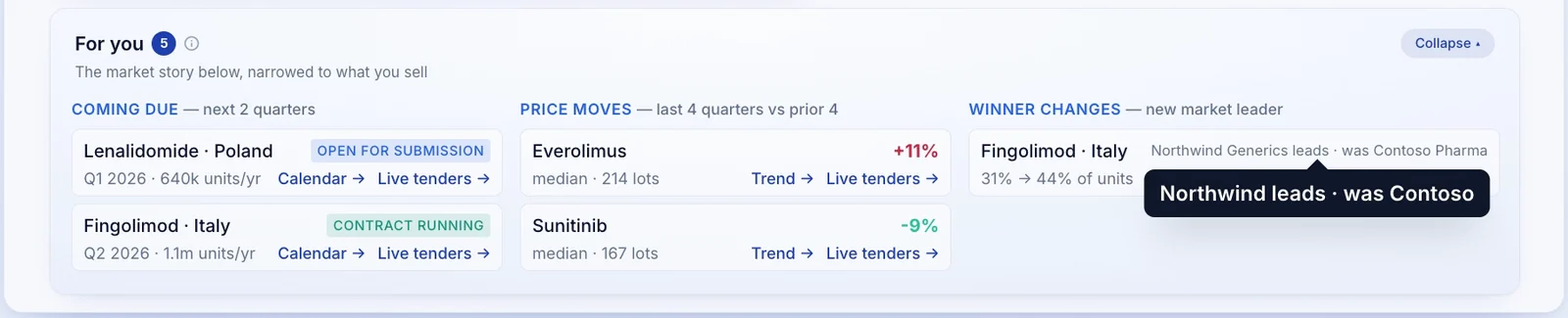
The market narrowed to the products you sell: tenders coming due, price moves and changes in who wins. Screens below use demo data.
Built on a decade of healthcare tender data
Healthcare tenders and awards in the database
Languages read, with notices searchable in English
Countries refreshed every day, with more markets connected on request
Years of award history for price and competitor analysis
Who works with RGS
of Europe's leading generics manufacturers have used the RGS platform
A top-10 global pharmaceutical company is an RGS client
A Dutch generics manufacturer that sells through partners runs its tender and pricing intelligence on RGS
Improvement in tender visibility
Increase in tender win rate reported by clients
Increase in annual tender revenue
Results reported by RGS clients. Individual outcomes depend on portfolio, markets and starting point.
How RGS works in practice
Pricing guidance, from our team
Price on what has actually won in comparable tenders
Built from awards for the same molecule, buyer type and lot structure.
- Win probability across your price range
- Expected value alongside win rate
- Scenario comparison before you submit
Award and Price Intelligence
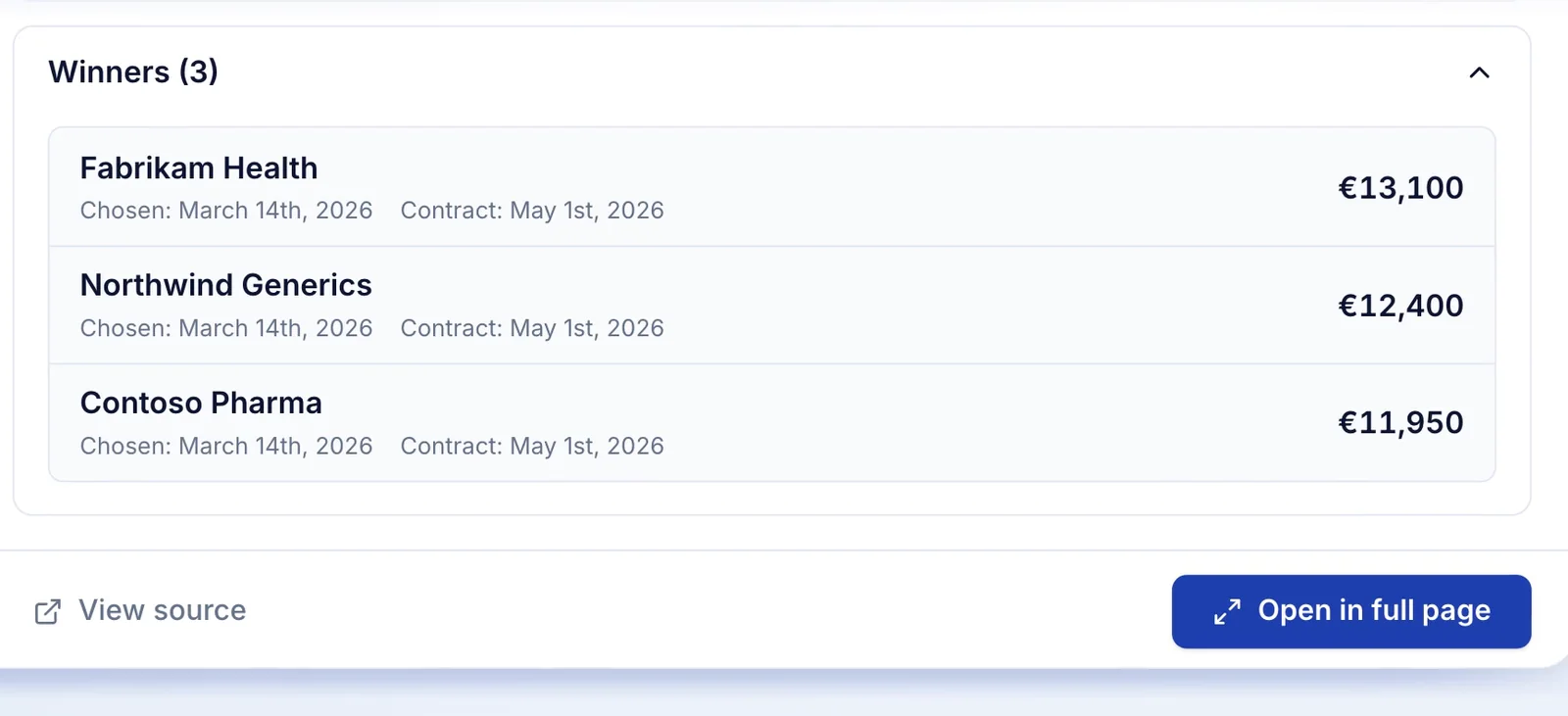
Who won, at what price, and how far off you were
All winning partners, their ranking and their prices where the evidence exists, including multi-partner awards.
- Bidder prices, where the buyer publishes them
- Distance to the winner on your own bids
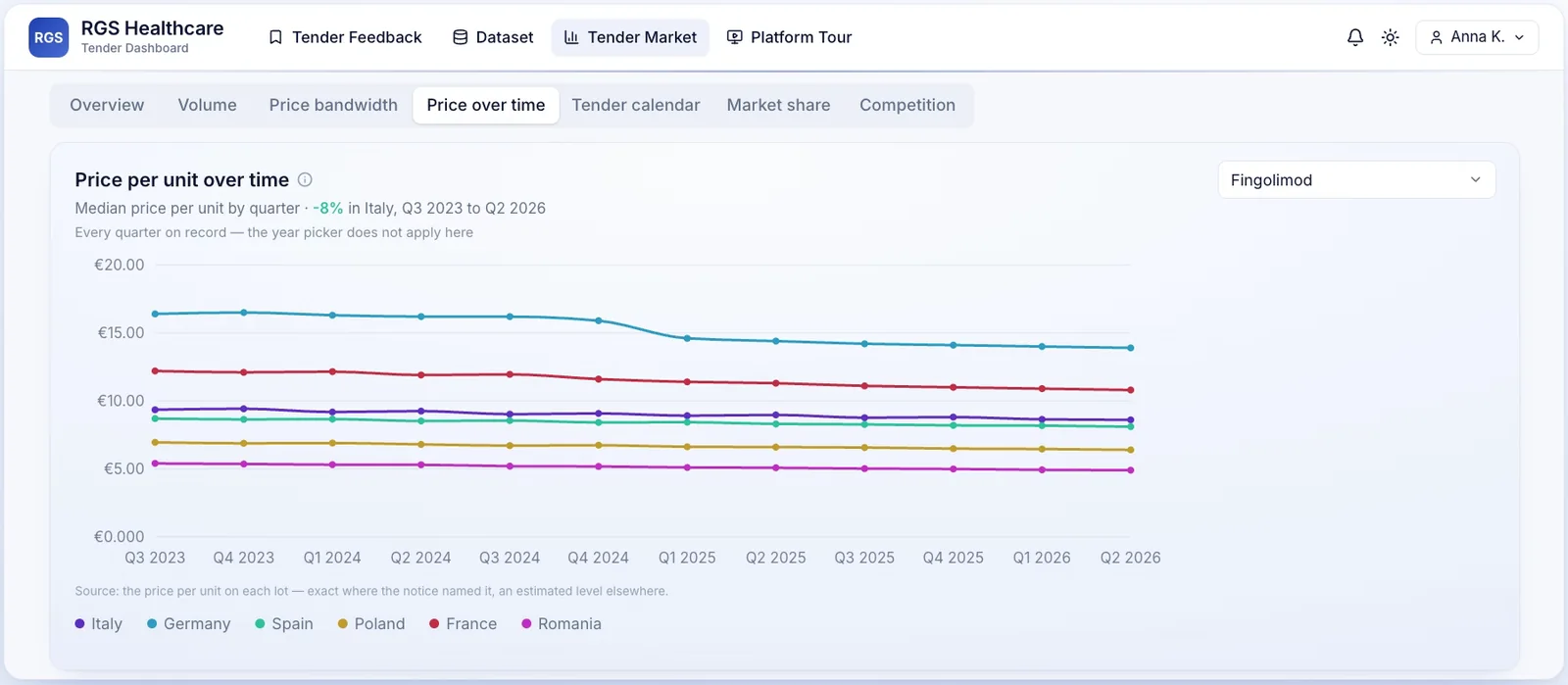
- The same molecule's price in neighbouring markets
Regulatory intelligence
Who may sell it, who makes it, and who is coming next
Licence holders are linked to their parent group, so a new holder, a supplier switch or a competitor filing shows up straight away.
- New holders, withdrawals and transfers on your molecules
- Manufacturers and contract makers behind each holder
- Pending filings and competitor portfolios
For companies that sell into public healthcare
Win the rounds that decide your volume
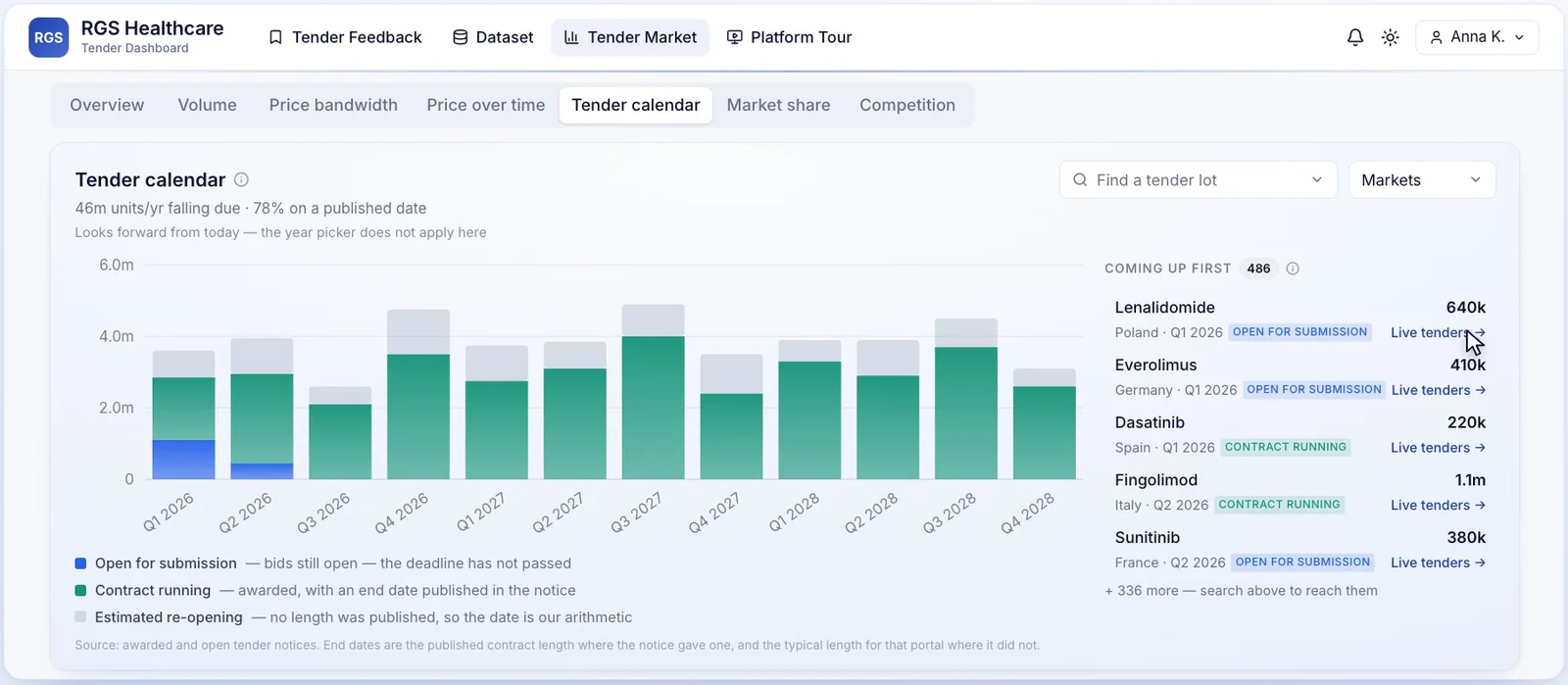
Insurer contracts, national frameworks and hospital tenders in one calendar, with prices that hold up.
For generics Branded pharmaSee where your brand is bought and challenged
Loss of exclusivity, competitor entry and price references, buyer by buyer.
For branded pharma MedTechDevice and consumables tenders, market by market
Specification-level matching, award history and market entry support.
For medtech Tender and bid teamsMore bids out, with less manual work
Discovery, qualification and first drafts handled, so your team spends its time on strategy.
Proposal AINumbers you can check before you rely on them
A sales manager who finds one wrong price stops using the tool. That is why each figure links back to its source notice.
- Traceable
Prices, winners and volumes can be traced back to the notice it came from.
- Estimates labelled
Stated volumes and our estimates are shown side by side, never blended into one number.
- Strength by strength
Prices are kept per strength and presentation, so tablets never dilute injectables.
- Averages only with enough data
A market average appears only where enough awards stand behind it.
- Clear about gaps
Some prices are never published. We show where, instead of filling the gap with a guess.
- Checked by people
Analysts review high-value tenders and awards by hand before they reach you.
Nobody has to feed it
Tenders, results and re-tender dates arrive by email and in the platform, routed to the right owner. No central spreadsheet.
Down to the single tender
Open a molecule and see the tenders behind it: lots, strengths, winner, prices and the next date.
Tender rules differ by country. Our guides explain how each market works
German insurers split awards across partners, Italian regions run their own frameworks and Nordic buyers tender nationally. Our country guides explain each route.
You talk to the founders
RGS is run by its two co-founders, Roel Sarelse and Stavros Therapontos. One of us runs each demo and stays involved after you sign, together with our engineering team.


What clients changed, and what it delivered
Reshaping a generics portfolio around where tenders are won
A leading generics manufacturer wanted to know which products were holding the portfolio back and which deserved more investment.
+20% revenue from the optimised portfolio
Read the case Dutch generics manufacturerGiving a manufacturer's partners the prices to compete
A Dutch generics manufacturer that sells through distribution partners and does not bid itself had little visibility of the tenders its partners were fighting.
Higher partner win rates on the manufacturer's molecules
Read the case Branded pharma and medtechUsing tender data for market access as well as bidding
Branded pharmaceutical and medtech companies wanted to know where their products would be bought, at what price and against whom.
Ranked target markets by tender demand and price
Read the caseFrequently asked questions
What does RGS Healthcare Solutions do?
RGS gives pharmaceutical and medtech companies one view of the tenders, marketing authorisations, manufacturing networks and competitors behind the molecules they sell. The platform finds and prices tenders, tracks who may sell and who makes each product, maps competitors and feeds supply chain planning. Alongside the software, our team can run bids, produce reports and support market entry.
How does tender matching work?
We collect tender notices and documents across Europe every day. Language models read each one, extract the products, lots, volumes, deadlines and award criteria, and match them to your portfolio by molecule, strength, presentation and market. Irrelevant notices are filtered out, and your feedback improves the matching over time.
Which countries does RGS cover?
All 27 EU member states are refreshed every day, together with the United Kingdom, Norway and Switzerland. Selected markets outside Europe are covered on request. Our Europe pages explain how procurement works in each major market.
Does RGS only cover tenders?
No. Alongside tenders, the platform tracks marketing authorisation holders, pending filings, manufacturing and batch release sites and competitor portfolios, and uses all of it for supply chain planning, profitability checks and supplier risk.
What is competitive intelligence for pharmaceutical tenders?
It is the analysis of who wins which tenders, at what price and on which criteria. RGS records awards at lot level, including multi-partner awards, which shows competitors' win rates by market and molecule, how prices have moved, and where the white space is.
How does pricing guidance find the right bid price?
Our models learn from historical awards for the same molecule, buyer type and lot structure, and from market factors such as the number of likely bidders. They estimate your probability of winning at each price, and you choose the price that maximises expected value, balancing the chance of winning against margin.
See your own tender results and prices in thirty minutes
We load your products and markets beforehand, so the demo runs on your data.